


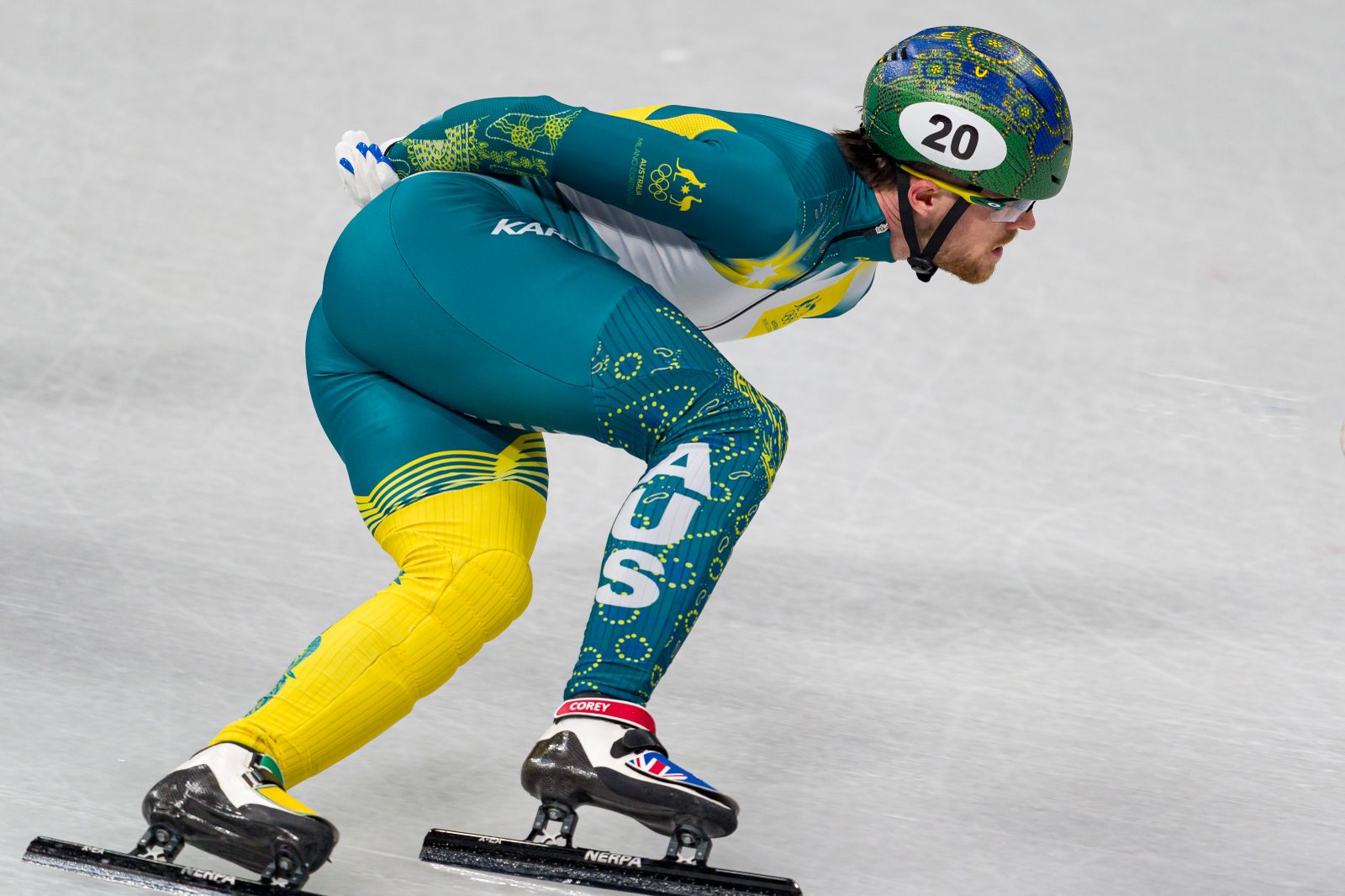
Brendan's Story
Fast Facts
Sport: Short Track Skating
Event: Men’s 500m, Men’s 1000m, Men's 1500m
Olympic History: Beijing 2022, Milano Cortina 2026
Highlights: Bronze medal in the 2024 World Championship 1500m
Coach: Richard Nizielski
Year Born: 1997
About Brendan
Short Track Speed Skater Brendan Corey went into Milano Cortina 2026 with a bronze and fifth from the last two World Championships. Having trained with the Italians in the lead up to his second Games, Corey tackled an ambitious program finishing 17th (1500m), 26th (1000m) and 5th (500m).
Canadian-born and Australian-raised on the ice, Brendan grew up in Fredericton, New Brunswick in Canada, where he first laced up skates at eight. Drawn to the feeling of speed more than pucks, he moved from hockey to short track and never looked back. Embracing his Australian heritage through his mother and grandparents, he pursued a path to represent Australia at the highest level. When he is in Australia is based in Melbourne.
A pivotal moment came in 2019 when a concussion halted his Canadian pathway and prompted a rethink. After connecting with Australian Ice Racing officials, he joined the Australian program, attended a training camp in early 2020, and relocated in 2021. With domestic ice time limited during the pandemic, the squad based itself in Salt Lake City alongside the United States team. Corey completed a Bachelor of Commerce (supply chain and operations) along the way, while working with national coaches including Richard Nizielski (Richard being part of the relay team that ultimately won Australia’s first Winter Olympic medal).
Momentum built quickly. In November 2021 he made his first World Cup A‑final, finishing fifth over 1000 metres in Dordrecht Netherlands, a landmark result for an Australian male in the distance.

Beijing 2022 was the realisation of a childhood ambition. In the 1000 metres, Corey set an Australian record of 1:23.908 in his heat to advance directly to the quarter‑finals. His campaign ended in a dramatic last‑corner crash in the quarter‑finals; he also skated a personal best of 41.097 in the 500 metres and finished 15th overall in the 1000 metres.
Two seasons later he made history. At the 2024 International Skating Union World Short Track Championships in Rotterdam Netherlands, Corey won bronze in the 1500 metres, Australia’s first individual medal at the event in more than four decades. He finished behind China’s Sun Long and the Netherlands’ Jens van ’t Wout after a post‑race penalty reshaped the podium.
Brendan’s 2024–25 campaign underlined his rise in the middle distances. In December 2024, he posted multiple top‑25 results in Seoul. In February 2025, he reached the 1500m B‑final in Tilburg to place ninth, then advanced to the B‑final again at the Milan World Cup test event, finishing 10th and concluding the World Cup season ranked 10th in the 1500m. He finished the season with another strong showing at the World Championships in Beijing, where he was fifth in the 1500m A-final but crashed out in the 1000m heat.
Opening the 2025–26 Olympic season in Montréal, Brendan reached the B‑final in the first of two World Tour events to place 11th in the 1500m, then made the semi‑finals in the second meet. At World Cup 3 in Gdansk, Poland, he was second in the B-final for 10th overall in the 1500m and eliminated in the 500m repechage semifinals to rank 23rd. At the last World Cup of the season in The Netherlands in late November, Brendan reached the 1500m B-final to be 11th overall, finished 24th in the 1000m and 26th for the 500m.

Through the early years of his Australian career Brendan built a reputation for resilience and work ethic, qualities forged in part by being told often as a junior that he was “not good enough,” a challenge he credits with making him mentally and physically stronger.
Read More

